What is ECPT?
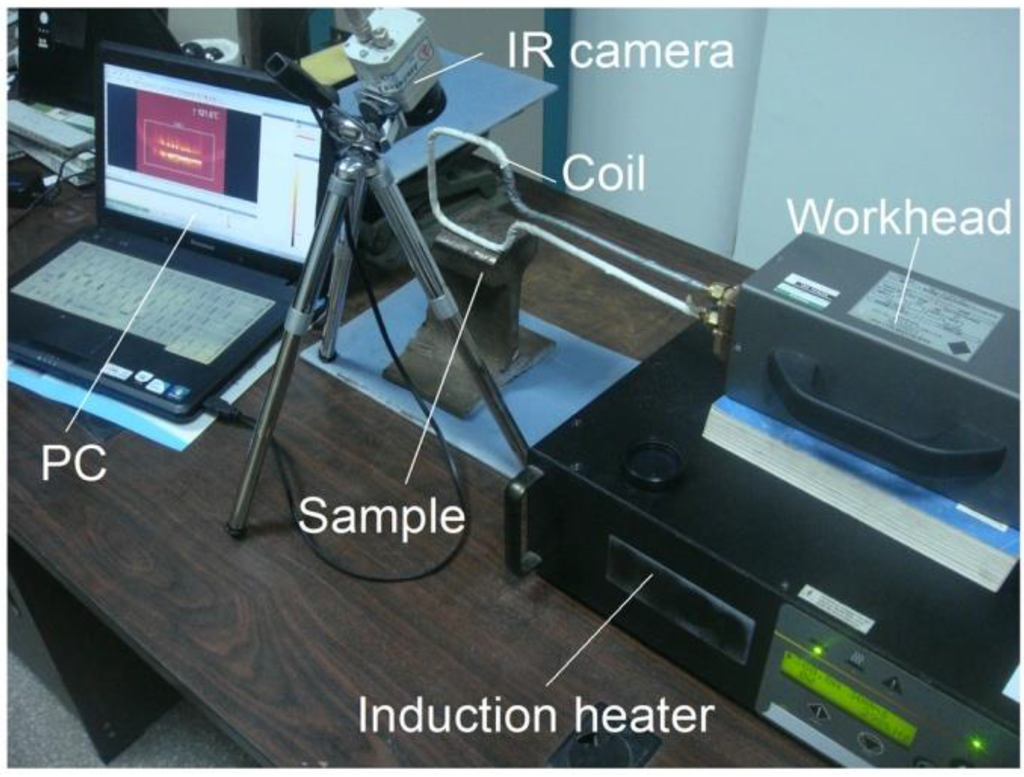
Eddy Current Pulsed Thermography (ECPT) is an active thermography method that couples electromagnetic induction with infrared imaging for rapid, non-contact inspection.
Background
Why ECPT matters for fast, large-area inspection.
Eddy Current Pulsed Thermography (ECPT), often discussed alongside inductive thermography, is an active inspection technique in which a short electromagnetic excitation is used to generate transient heating, and an infrared (IR) camera records the resulting surface temperature evolution.[6]
ECPT is particularly attractive when a fast, non-contact method is needed over a relatively large area, and when the inspection task benefits from automated analysis of thermal sequences.[4][6]
Beyond metals, ECPT-type approaches have also been demonstrated for electrically conductive composites, including CFRP, where the current preferentially follows the carbon fibre network and can support defect-sensitive heating patterns.[1][6]
In practice, ECPT also sits within a broader family of eddy-current-based NDT methods where robust sensing hardware and embedded acquisition are critical for deployment in real inspection environments.[5]
Principle
How electromagnetic heating becomes a thermal signature of damage.
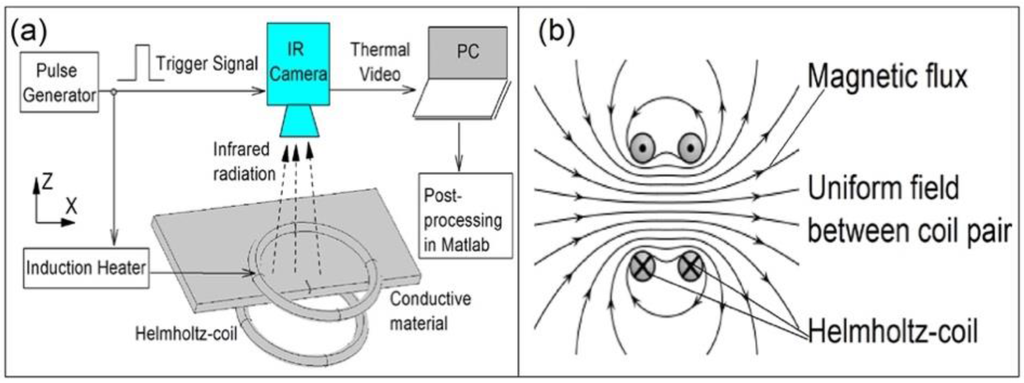
In ECPT, an excitation coil driven by an alternating current induces eddy currents in an electrically conductive target. Due to ohmic resistance, Joule heating is generated, and the transient temperature field is captured by an IR camera.[6]
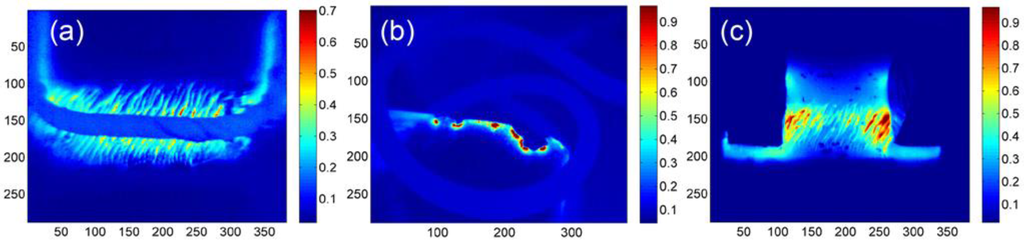
Defects such as cracks, lack-of-fusion, or delamination can disturb both the eddy-current distribution and subsequent heat flow, producing local temperature contrast that evolves over time and can be analysed for detection and characterisation.[6]
The excitation configuration matters. Different coil arrangements (for example, line coils, Helmholtz-type coils, or ferrite-yoke-assisted setups) are used to trade off heating uniformity, inspection sensitivity, and suitability for complex geometries.[4]
A widely used enhancement strategy is pulse-compression-based ECPT (often referred to as ECPuCT), where coded excitation and matched-filter-style processing improve signal-to-noise and enable more stable feature extraction from the thermal impulse response.[1][2]
Applications
Typical inspection tasks where ECPT has shown strong capability.
Crack detection and sizing in metals. Pulse-compression ECPT has been used to detect surface and subsurface defects in aluminium, and to quantitatively relate thermal-response features (for example, a crossing-point feature) to defect depth in a monotonic way under controlled conditions.[2]
Material and defect characterisation with tailored excitation. ECPT excitation configurations have been systematically studied for ferromagnetic and non-ferromagnetic components, with comparisons against conventional line-coil setups and discussion of applicability to complex shapes (for example, blade edges and rail tracks).[4]
Complex weld geometries. Recent work has also demonstrated ECPT-based detection and reconstruction of welding defects in irregular geometries, highlighting ongoing progress toward more challenging, real-world components where geometry is not ideal.[3]
Applications for WTB
How ECPT and thermography connect to wind turbine blade inspection.
Wind turbine blades (WTBs) are predominantly composite structures where common damage modes include delamination, debonding, and impact-related defects. Thermography is attractive for WTBs because it can provide rapid, wide-area screening and can be integrated with automated data processing pipelines.[8][9]
For electrically conductive regions (for example, CFRP substructures), ECPT-type excitation can generate defect-sensitive heating patterns, and pulse-compression strategies have been shown to support quantitative depth-related analysis in CFRP delamination studies.[1][6]
For non-conductive composite regions (for example, GFRP), ECPT-inspired approaches can be enabled via an inductive heating layer, which introduces controlled heating suitable for quantitative defect evaluation in glass-fibre reinforced polymer specimens.[7]
In this project, the goal is to move beyond “visual hot-spot screening” toward thermographic reconstruction and inversion tailored to curved blade geometries, so that defect signatures become more interpretable and more comparable across positions on the blade.

References
References are cited in the text using superscripts [1]–[9].
- Q. Yi, G. Y. Tian, H. Malekmohammadi, J. Zhu, S. Laureti, and M. Ricci, “New features for delamination depth evaluation in carbon fiber reinforced plastic materials using eddy current pulse-compression thermography,” NDT & E International, vol. 102, pp. 264–273, 2019. doi: 10.1016/j.ndteint.2018.12.010
- Q. Yi, H. Malekmohammadi, G. Y. Tian, S. Laureti, and M. Ricci, “Quantitative Evaluation of Crack Depths on Thin Aluminum Plate Using Eddy Current Pulse-Compression Thermography,” IEEE Transactions on Industrial Informatics, vol. 16, no. 6, pp. 3963–3973, 2020. doi: 10.1109/TII.2019.2943669
- R. Wang, H. Malekmohammadi, Q. Yi, G. Y. Tian, S. Laureti, A. Samaei, and M. Ricci, “Advanced detection and reconstruction of welding defects in irregular geometries using eddy current pulsed thermography,” NDT & E International, 2025, Art. no. 103398. doi: 10.1016/j.ndteint.2025.103398
- G. Y. Tian, Y. Gao, K. Li, Y. Wang, B. Gao, and Y. He, “Eddy Current Pulsed Thermography with Different Excitation Configurations for Metallic Material and Defect Characterization,” Sensors, vol. 16, no. 6, 843, 2016. doi: 10.3390/s16060843
- C. Camerini, J. M. A. Rebello, L. Braga, R. Santos, T. Chady, G. Psuj, and G. Pereira, “In-Line Inspection Tool with Eddy Current Instrumentation for Fatigue Crack Detection,” Sensors, vol. 18, no. 7, 2161, 2018. doi: 10.3390/s18072161
- B. Oswald-Tranta, “Inductive thermography – review of a non-destructive inspection technique for surface crack detection,” Quantitative Infrared Thermography Journal, 2025. doi: 10.1080/17686733.2024.2448049
- J. Liu, W. Huang, H. Lu, W. Liu, and Y. He, “Eddy current pulsed thermography aided with inductive heating layer: quantitative evaluation of defects in non-conductive glass fibre reinforced polymer,” Composites Part B: Engineering, vol. 301, 111517, 2024. doi: 10.1016/j.compositesb.2024.111517
- H. M. Vasconcelos, P. J. Sousa, S. Dias, N. Viriato, T. Domingues, P. J. Tavares, and P. M. G. P. Moreira, “UAV-Based Thermographic Inspection of Wind Turbine Blades for Structural Integrity Assessment: Preliminary Findings,” Procedia Structural Integrity, vol. 68, pp. 795–801, 2025. doi: 10.1016/j.prostr.2025.06.132
- Chiwu Bu, Xin Huang, Peng Chen, Weiliang Bai, Qingju Tang, “Delamination defects detection for wind turbine blades based on pulsed infrared thermography,” Nondestructive Testing and Evaluation, 2025. doi: 10.1080/10589759.2025.2501701