Project Summary
Thermographic reconstruction and inversion for wind turbine blades
Project Introduction
Funding scheme and team structure.
This project is funded by the International Science Partnerships Fund (ISPF) under the International Collaboration Awards 2024 – Brazil and South Africa scheme.
Northumbria University (UK) coordinates the overall technical delivery and integration, leading the development of thermography-based inspection capability for curved composite structures and the associated reconstruction and interpretation workflow. Northumbria also drives training and knowledge exchange for early-career researchers across the programme.
Federal University of Rio de Janeiro (Brazil) leads Brazil-side experimental development and application-oriented validation, including heat-transfer modelling support and practical inspection trials on relevant blade components and curved industrial structures. UFRJ also enables local engagement and pathways for adoption within Brazilian wind-energy contexts.
Newcastle University (UK) contributes specialist expertise in electromagnetic NDT and thermographic data processing, supporting advanced excitation concepts and robust reconstruction approaches for complex geometries. Newcastle also supports dissemination activities, including joint seminars and workshops on thermal NDT and AI-enabled data interpretation.
Overview
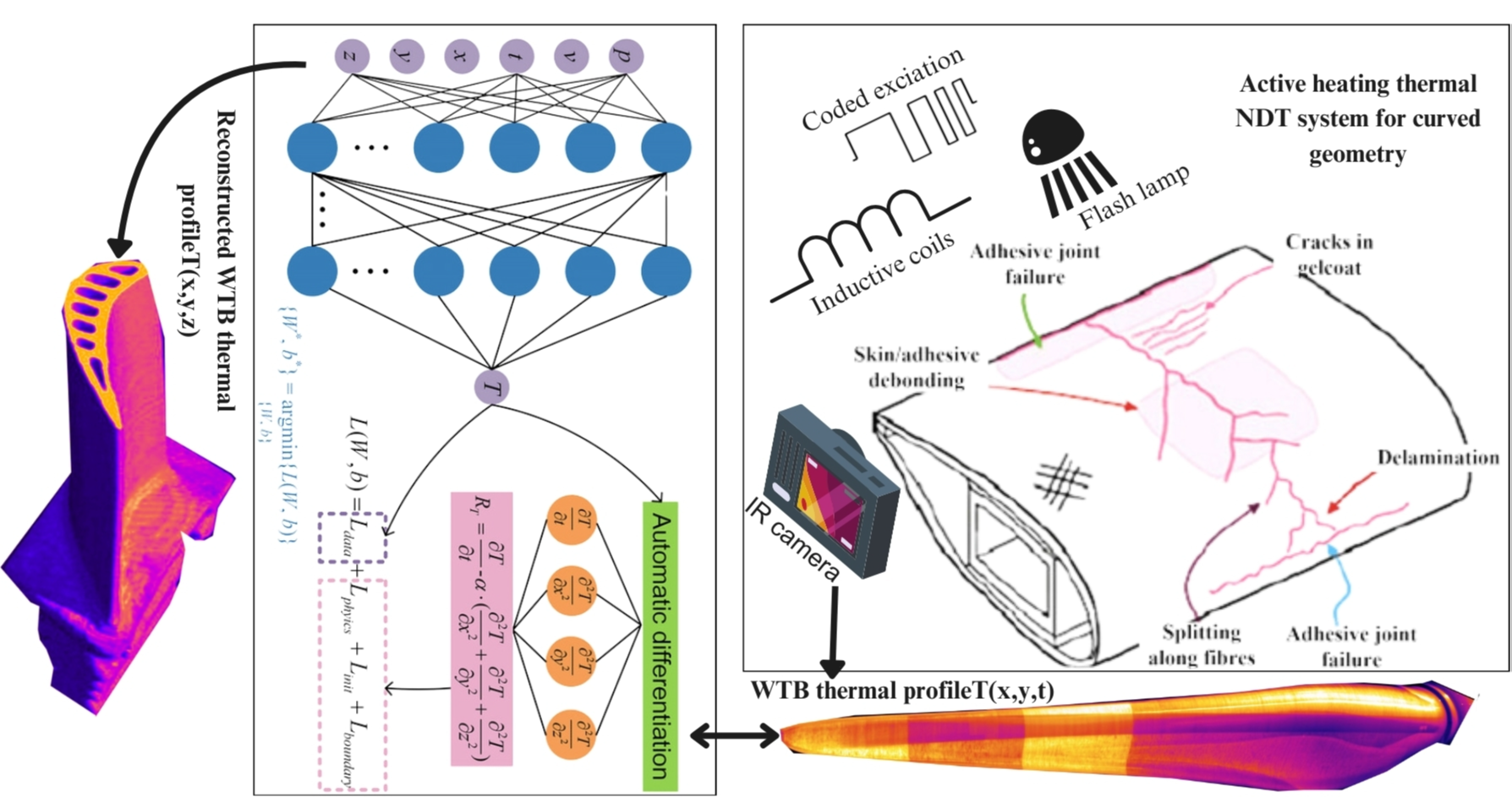
Introduction and background (aligned with Figure 1).
Brazil is expanding wind energy as part of its long-term decarbonisation pathway, and wind turbine blades (WTBs) are critical assets whose integrity directly affects safety and operational efficiency. Thermography is a widely used non-destructive evaluation (NDE) technique for WTB inspection: a controlled heat stimulus is applied and the resulting surface temperature evolution is monitored to infer subsurface anomalies that alter thermal transport behaviour [1,2].
In real blades, conventional thermographic inspection faces key challenges. First, complex curved geometry (especially corners and edges) can cause non-uniform heating and shadowing effects, reducing the reliability of defect characterisation [1,2]. Second, accurate interpretation requires robust forward heat-transfer modelling, which becomes computationally demanding and error-prone in complex geometries and for anisotropic composite materials [3]. Third, many inversion approaches rely on simplified heat-transfer assumptions; their accuracy can degrade when heat flow is influenced by complex geometries, heterogeneous materials, and varying boundary conditions [4].
Figure 1 provides a high-level view of the project context and the overall inspection-to-interpretation workflow for curved composite blades, motivating the need for geometry-aware thermography reconstruction and inversion.
Aims and Methodology
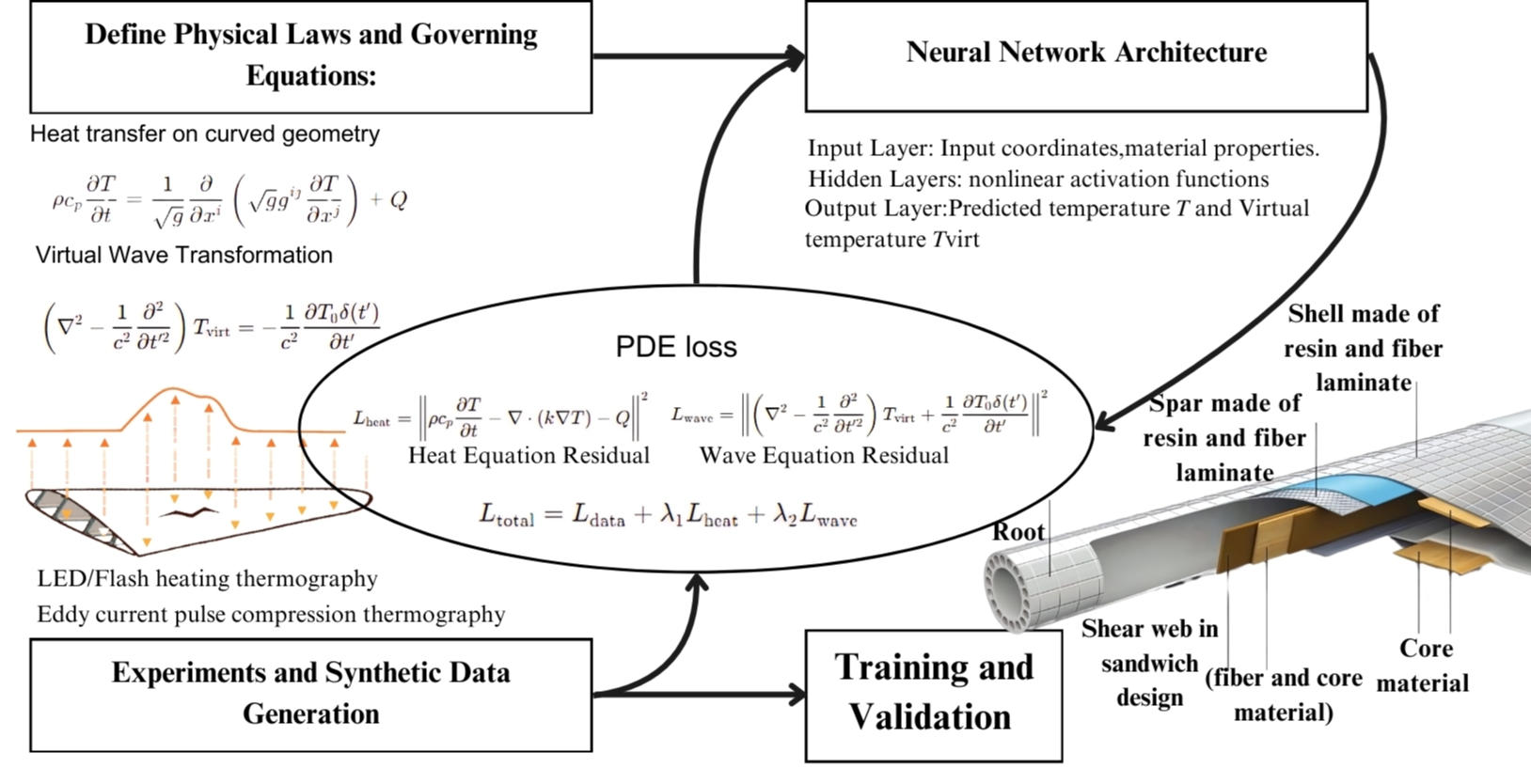
High-level aims and methodology (aligned with Figures 2 and 3).
To address the above challenges, the project aims to improve the effectiveness of wind turbine blade inspections by developing next-generation thermography reconstruction and inversion methods, leveraging complementary UK and Brazilian expertise. The focus is on improving the reliability of thermal data acquisition on curved composite surfaces, and enabling more interpretable, physics-consistent reconstruction for defect assessment [3,4].
As illustrated in Figure 2, the methodology includes enhancing thermal excitation and measurement quality for curved blades. This is achieved through advanced excitation strategies, such as coded/pulse-compression concepts that improve signal-to-noise ratio and resolution, and coil/excitation configurations designed to better adapt to curved geometries [5]. These developments target more uniform, repeatable heating and more informative thermal responses for subsequent interpretation.
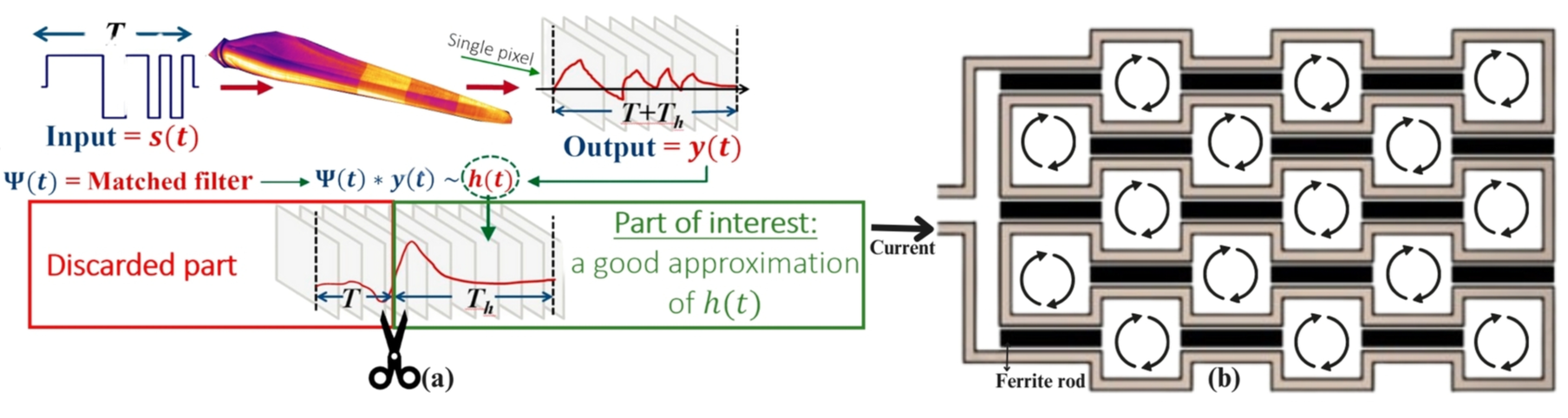
Figure 3 summarises the reconstruction and inversion direction: the project advances thermography reconstruction by combining physics-based understanding with modern learning-based tools, aiming for robust performance under realistic heat-transfer conditions. In particular, wave-inspired thermal reconstruction concepts and physics-informed learning (for example, incorporating physical loss and constraints during model training) are used to improve the fidelity and interpretability of reconstructed results while remaining adaptable to different blade designs and operating scenarios [6].
References
- G.Y. Tian., et al. IEEE Transactions on Industrial Electronics 63.10 (2016): 6305-6315.
- Cesar Giron Camerini et al. Journal of Nondestructive Evaluation 40.3 (2021): 58.
- Yi, Q., et al. Composites Part B: Engineering 178 (2019): 107461.
- Yi, Q., et al. NDT & E International 122 (2021): 102474.
- Yi, Q., et al. NDT & E International 102 (2019): 264-273.
- Thummerer, G., et al. NDT & E International 112 (2020): 102239.